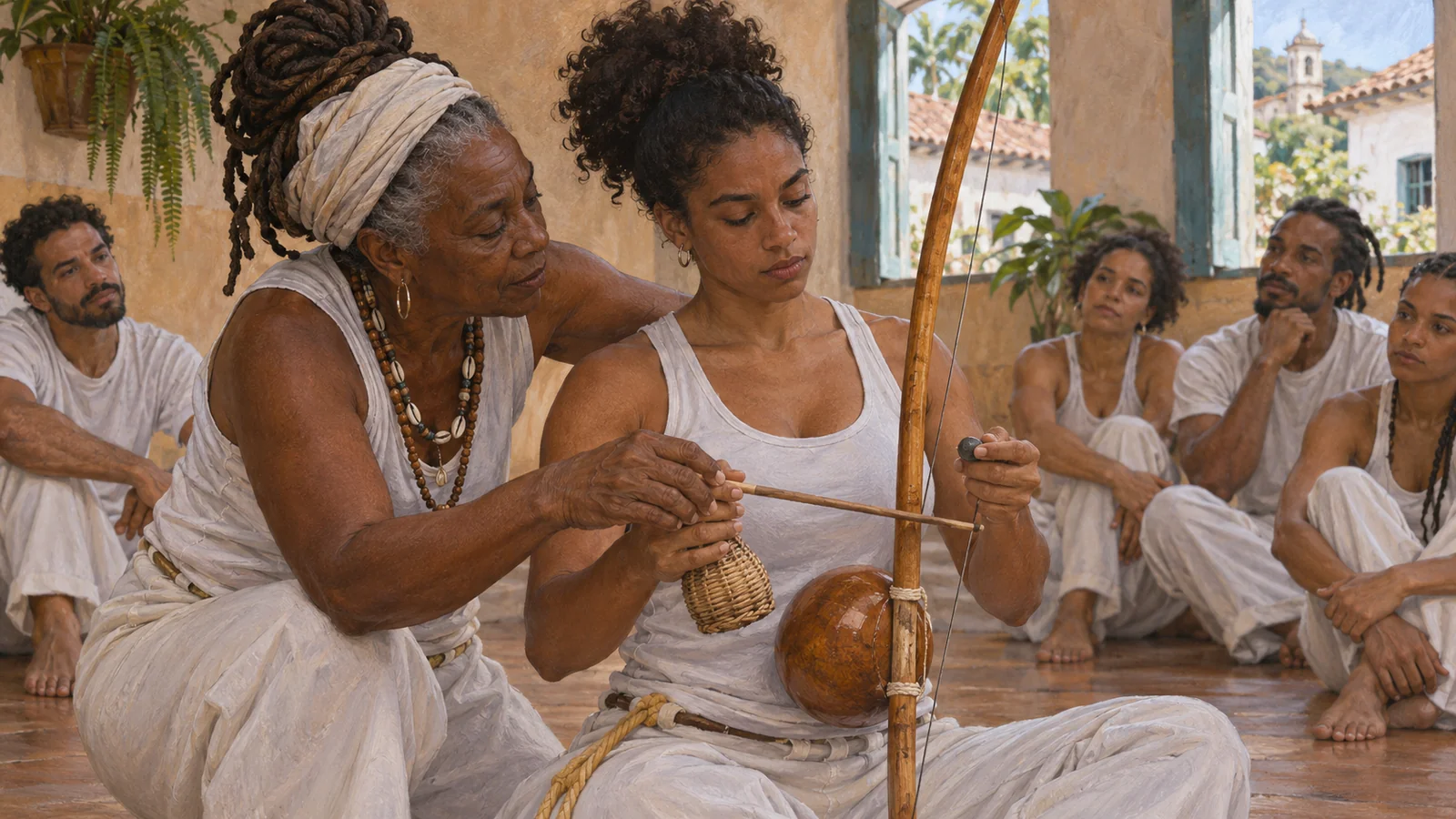
Learning to take part
Imagine arriving at a roda for the first time. Two people are playing in the middle, while someone welcomes newcomers and shows them when they can enter. Brazil’s heritage record describes the knowledge held by capoeira mestres and mestras as something shared through speech, gesture and participation. Part of it comes from watching an experienced person make room for someone else or step in to help a game continue.
Recognition grows within a community
Brazil’s National Institute of Historic and Artistic Heritage, Iphan, describes practitioners who have learned within the tradition and earned recognition from their peers. Brazil’s Ministry of Culture describes how they may guide a game, tell a story, teach a berimbau rhythm or train new practitioners. One way to see their work is to watch what a student can do on their own when they return to the next roda. Groups can structure that learning in different ways.
Two related forms of heritage
Brazil approved separate registrations for the roda and the work of capoeira mestres in 2008. The circle went into the register of forms of expression and the teaching tradition into the register of knowledge. In November 2024, Iphan’s advisory council renewed the recognition of the teaching tradition and explicitly added mestras to its official name. The wording acknowledges women’s role in passing on an Afro-Brazilian tradition from one generation to another.