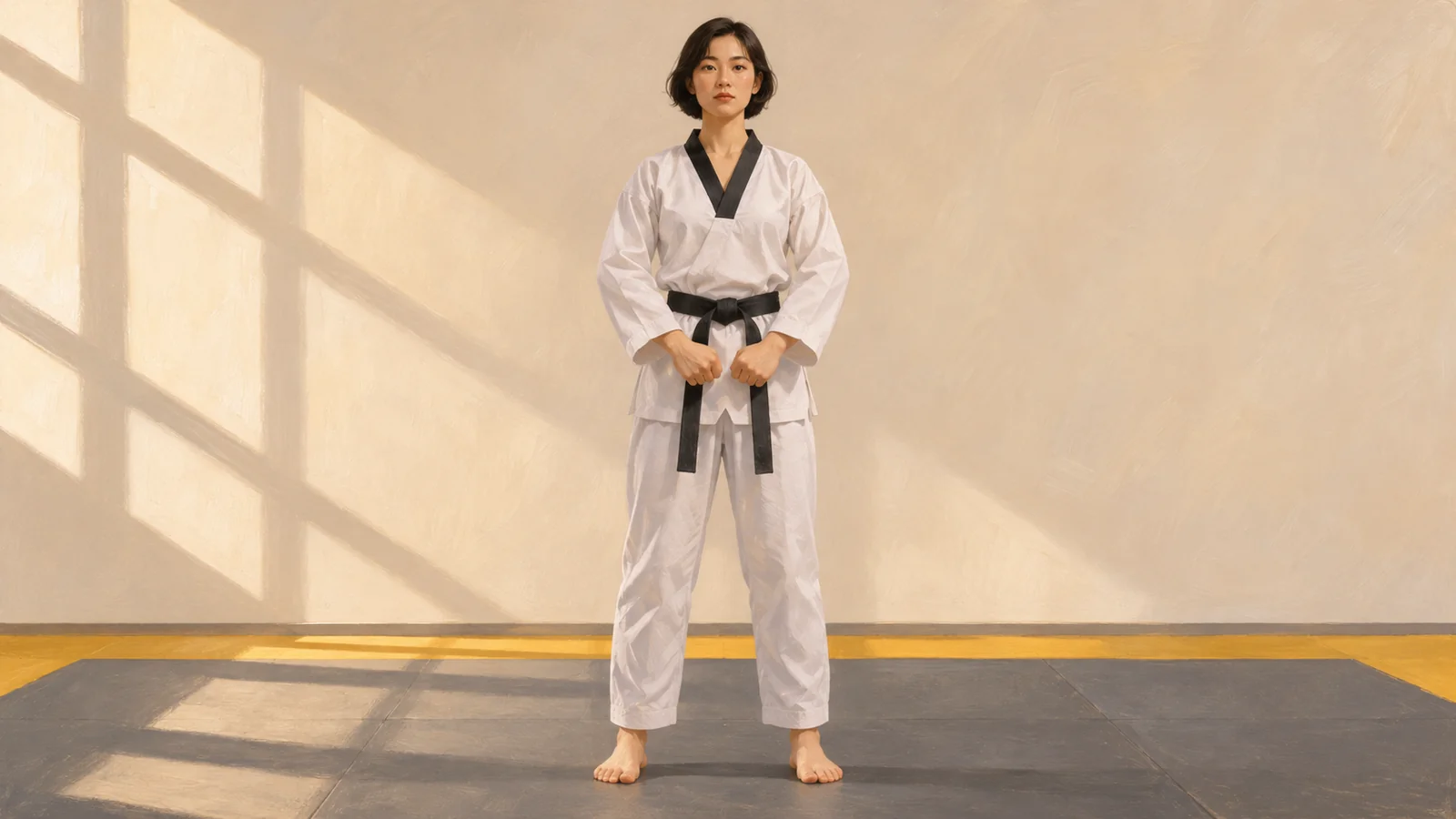
A sequence worth watching in full
British Taekwondo describes poomsae as prearranged sets of defensive and attacking movements, practised without contact. Its rulebook explains the sequence in relation to imaginary opponents. An exchange of blows with another person is not needed for a demanding task: the performance combines technique, coordination and concentration.
For a first viewing, choose a camera angle that shows the whole body. A close-up of a kick can hide the supporting position that prepares it and the transition that follows.
Follow the centre of the body
Kukkiwon provides a specific example in its explanation of Shipjin, one of the forms in its system. It connects the form's path with maintaining a central axis when moving forwards, backwards or sideways, linking this to body alignment and balance. This explains that particular form; it is not a formula for judging any sequence from memory.
While watching, follow one change of direction: where the feet settle, how the trunk moves and how the next action begins. That continuity is also part of the performance.
Accuracy and presentation
For recognised poomsae, British Taekwondo's June 2025 document distinguishes accuracy from presentation. Accuracy includes basic movements, details of the form and balance. Presentation considers speed and power, rhythm and expression of energy. Performing everything as quickly as possible is not the whole task.
Its explanations connect rhythm with links and changes between actions. We can notice those differences without inventing a score from the sofa. This guide uses that version to explain concepts; it does not announce an update to the world rulebook.
Check which discipline you are watching
The same text distinguishes recognised poomsae from freestyle, which involves music, choreography and its own technical-skill and presentation criteria. Automatically transferring expectations from one to the other can confuse a viewer. Identify the event and consult its rules before comparing performances.
As a small viewing exercise, watch a complete performance while following foot placement, then watch again for rhythm. You do not need to know every name to start appreciating the relationship between positions, transitions and movements. A useful next question is which form was performed and how its school explains it.